by Romina Ciulli and Carole Dazzi
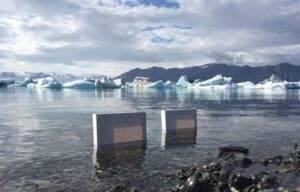
Roberto Ghezzi’s artistic research is based on an abiding interest in the natural landscape and stems from a need to establish a deeper relationship with it, not just a merely representational connection, but above all participatory. In fact, his experiments take place directly within pre-selected natural spaces, and consist of innovative conceptual works, developed through a humanistic-scientific approach. This dual methodological process intertwines the aesthetics of art with the creative dimension of nature itself. This gave rise to his series of creations known as Naturografie, installations which take shape through a direct contact with different landscape contexts, where nature itself takes on the role of creator of the artwork.
These works explore a variety of concepts: from transformation to time, from naturalistic themes to climate change. Aspects that we find in projects such as Greenland Blurring (2025), Chronos (2025), The Mountain’s Eyes (2025), or Iceland Still (2024). Let’s talk with the artist.
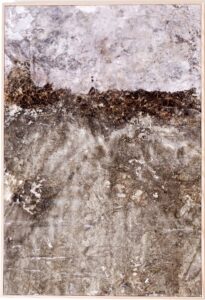
Your Naturografie are the result of a well-defined process, starting with the choice of the environment and media, followed by an analysis of natural processes and a determination of the required time, all the way to understanding the moment when the result can be considered complete. Can you explain how this performative practice was born and developed?
The first naturografie, about 15-20 years ago, were simple experiments in which everything, apart from the will which sparked the idea, so the desire to engage, as an artist, in direct dialogue with the landscape, was left to chance and improvisation. Then, as with everything, all things were refined, both conceptually and “operationally”. Today, a project to create naturografie involves different approaches, different materials, extended timeframes, specific goals and collaborations, and much more.
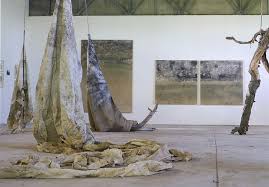
In these works, where the artist’s hand seems consciously removed from the creative process, nature becomes the subject/object of its own representation. The work’s evolution thus becomes the work itself, through an aesthetic narrative of continuous self-definition. How much do your input and that of nature influence the creation of your work?
Both are mutually necessary: the artist triggers, chooses, controls, extracts, and makes everything happen. Nature, simply, happens. It presents itself. It appears. There is a delicate balance here, as between origin and artifice.
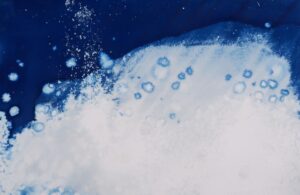
In the exhibition Greenland Blurring. Art, Science and Climate Change in The Polar Land (2025), held in Copenhagen, ice is the protagonist of a scientific analysis that provides a romantic and metaphorical narrative of the landscape depicted. Can you tell us about this project and what techniques you used to create it?
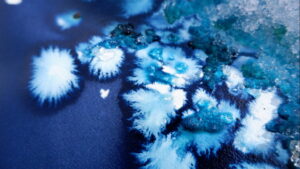
The exhibition I brought to the IICC featured works created as part of The Greenland Project, cyanotypes of melting ice. During this 2022 expedition, in collaboration with the CNR ISP, I created several works using melting icebergs, working in areas affected by a red algae which grows precisely in regions where ice sheet melting is particularly intense.
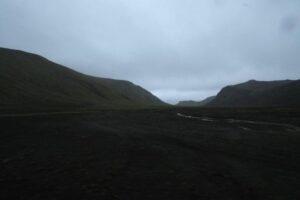
Your works are often the result of collaboration with scientists or scientific experts. This is the case with the Iceland Still project (2024), created in Iceland with the collaboration of some quantum physicists. What role does science play in defining your projects?
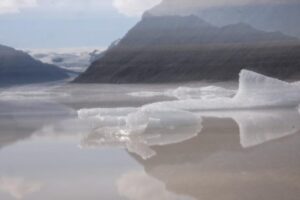
Yes, the project I created in Iceland this year was dedicated to time. My works, almost always expressing some aspect of a natural environment, whether they interact with light or the materials of a given location, can easily become matrices that collect data on an ecosystem, whether about life, pollution, or other aspects of great scientific interest. A virtuous circle has been created over time, fostering the artistic research and perhaps stimulating a scientific one and, above all, contributing to dissemination.
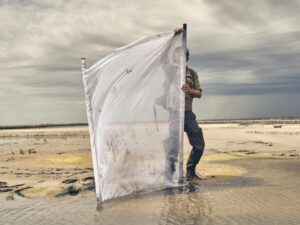
In your installations, you use a variety of media: from linen, organza,and cotton canvases. to cyanotype photography and cameras. The specific sites you’ve identified for your research are just as diverse: Alaska, Iceland, Macedonia, and so on. Can you explain the criteria you use to make these choices?
The materials are chosen based on the specific places and situations I will be interacting with, trying however to vary often, through experimentation and adaptation, while maintaining a strong conceptual coherence of my work.
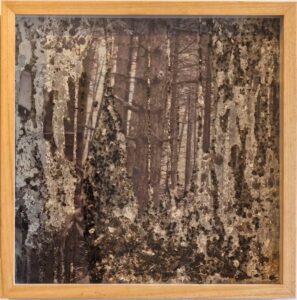
What ultimately emerges from your works seems to be a self-portrait of the landscape, in which natural processes are layered into a constantly evolving narrative. When do you define the end of a work, and how do you choose its mode of fruition?
The work is ready (I wouldn’t call it finished…) when a balance has been reached between the environment and the material, where both are still present but somehow harmoniously fused. One step too soon, there’s too much artifice, one step too far, there’s too much nature, with the risk of losing everything.
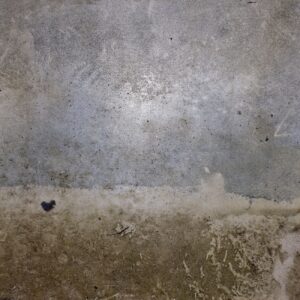
In your artistic journey, the theme of transformation and, consequently, time, takes on an important role. Let’s think, for example, of the exhibition Χρόνος (2025). Your works, in fact, demonstrate that everything is transitory, everything is constantly changing, both in life/nature and art. How much of a role does temporal dynamics play in your research?
Time, along with environmental performance, is the other element I’ve never abandoned in my work, so much so that I could define it as “nature over time” or “landscape over time.” Therefore, it plays a fundamental and essential role, as much as delegating it to the environment.
Your early artistic training was focused on landscape painting. Subsequently, your role became more conceptual, abandoning classical painting techniques in favor of a new artistic expression, rich in ethical and interpretative implications. To what extent do you believe a work of art can still be experimented with to address contemporary dynamics?
I believe that continuous, daily experimentation is the very essence of a good artistic research as well as good science, today as yesterday and always.
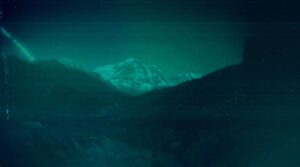
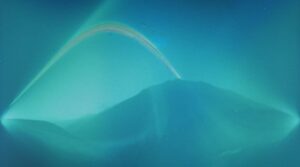
In your recent project The Mountain’s Eyes (2025), you chose to conduct research in the Himalayan mountains. Here, you used pinhole photography to capture the light illuminating the mountains, which seems to reflect what they see. Can you tell us how you developed this work and what emerged from it?
I used abandoned cans found along the route that would take me to the Himalayan base camp to try to illuminate the eyes of the mountains. In some ways, even in this case, I simply captured something that was already there, created by the light and the mountain, with its reflections and ravines. The images this produced speak volumes about the longevity of time, of synthesis, and of how the mountains don’t see us at all… because… perhaps because we’re moving too fast.
Are there any artists who have influenced your work or continue to inspire it?
Well, so many, it’s hard to name them all. I could name one for every historical period, and one for every period of my life and research, from Leonardo to Friedrich, from Signorini to Rothko, and then Long, Burri, Kiefer, Penone, and a thousand others, more or less famous.
Can you tell us about your future projects?
I have a couple of dreams in the drawer, in remote places, which I’d rather not reveal, as they might never come true. Not so far away, I’m soon opening a solo exhibition at the Castello dei Conti Guidi in Poppi (December 13, 2025), while for 2026-27 I have a project for and with the MAG (Museo Alto Garda), and then many more waiting to be realized, between Turin and Canada.