by Romina Ciulli and Carole Dazzi
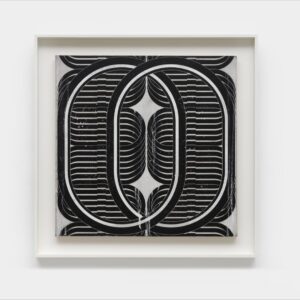
Geometric and minimalist abstraction lies at the heart of the artistic practice of Davide Balliano, an Italian-born painter, now based in New York. His work features rigorous, sculptural elements that appear to modulate and regenerate through a continuous series of aesthetic solutions. It is a process of constant formal evolution, deceptively static, dominated by the contrast between black and white, the use of different materials, and a cycle of structuring and deconstructing which gives rise to an intimate, personal narrative flow. Scratches, irregularities, variations, and imperfections emerge from this immutable yet chaotic continuum of forms, reconfiguring a compositional balance into which the viewer’s gaze is drawn, a visual representation that speaks not only to his own inner universe, but also to the collective imagination.
This non-figurative, rational artistic practice evokes contrasting reactions, and explores themes related to time and perception, ultimately offering a profound and sensitive interpretation of reality. Let’s delve deeper into the discussion with the artist.
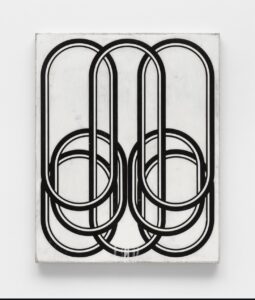
Your work is characterized by a sequence of straight and arched lines, sharp contrasts between black and white, and an alternation of solid and empty spaces. It is a composition which appears immutable, evoking sculpture, architecture, and is constantly transforming and dissolving. Could you explain how your artistic process unfolds, and why?
My work is rooted in the classic and everyday practice of painting. I often feel less like an author and more like a witness or a (receiver), someone whose task is to follow the direction the work itself seems to take, as if it possessed its own will. My exploration evolves slowly, through the repetition of precise patterns that shift in almost imperceptible ways. It is precisely this repetition that allows the work to expand: much like a muscle that grows when pushed to the point of exhaustion, the choreographies of my forms repeat themselves incessantly, until a system error, a crack in the structure emerges. When this happens, my role becomes one of supporting and fueling that internal rebellion, to see where it might lead. The result is usually an initial dissonance, which is subsequently reabsorbed into the overall harmony, bringing growth and change with it. Day after day, however, the practical dimension of my work remains simple and ancient: thought, drawing, painting.
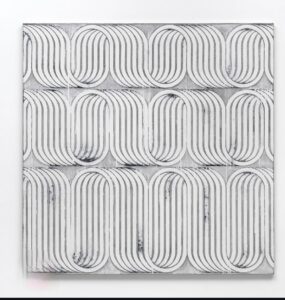
In your compositions, we witness unexpected variations that often disrupt the orderly geometric system to accommodate what might be termed “accidents”: irregularities, inaccuracies, abrasions, scratches, or drips. The canvas thus becomes a space where the act of creation serves as the primary means for exploring the expressive potential of the artistic process. Then, how does this methodological approach influence the outcome of your works?
The initial geometric framework serves merely as a formal pretext, a structure built to contain pockets of controlled chaos. I find pleasure in the visual heresy manifested through the scratches and abrasions on the painted surface: it acts as a negation of the modernist ideal of geometric perfection, a safeguard against the risk of dogmatic drift. The execution process is fundamentally manual moving from additive to subtractive stages, and is rooted in drawing and the layering of plaster and stucco, which are subsequently scraped back and smoothed. In this context, the inherent unpredictability of the material becomes a tool for an almost archaeological inquiry.
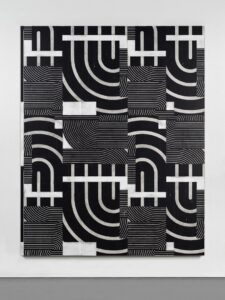
Details are revealed only through excavation, never by addition. The gesture evokes the notion of architectural ruins and the passage of time, transforming the canvas into a surface showing the marks of erosion and decay. Simultaneously, my practice acknowledges the impossibility of absolute control. During the final (and only) vertical phase of the work, the friction between the still-fluid stucco and the force of gravity produces drips and imperfections that are not entirely predictable. These natural, almost organic elements, anchor the work in a physical, corporeal dimension. A constant dialectical tension is thus generated between formal order and the chaos of the material, a tension that seeks its resolution in a harmonic synthesis and a fragile equilibrium.
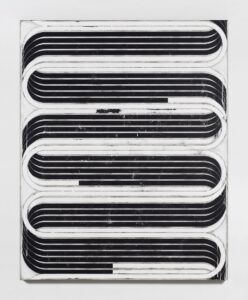
The use of black and white represents another fundamental aspect of your work, an element emerging not only on an emotional level, but also as something that, much like form, becomes the concrete material through which the work manifests itself. Furthermore, these essential tones evoke the optical influences of the 1970s. What role does color play in your artistic output?
For me, the use of black and white was an almost natural choice, dictated by the forms and materials I employ. My work does not stem from a desire for originality, though I do hope to define a language of my own, however humble or limited it may be in the context of art history. My creative inquiry follows personal obsessions, which have found their ideal environment through an engagement with the formal challenges of geometric abstraction.
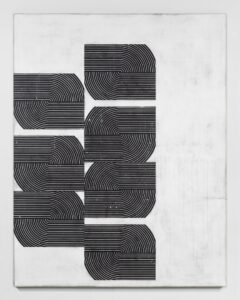
Having started with photography, my point of departure remains the framing, the balance between light and shadow: within this fundamental dynamic, black and white represent the most direct and minimalist mode of operation, they are the one element that is truly essential. Over the years, however, my structures have grown more complex, incorporating perspectival illusion and new internal contrasts. These frictions and impulses, inherent to the work itself, have generated a kind of internal warmth, a rise in temperature that made the introduction of color inevitable. For me, color is precisely that: warmth, an evolution of light and movement and, ultimately, tangible matter. Finally, I should clarify that, while I hold a deep admiration for the minimalist tradition of the 1960s and 70s, I have no real interest in Optical Art, with a few rare exceptions, such as the work of Bridget Riley.
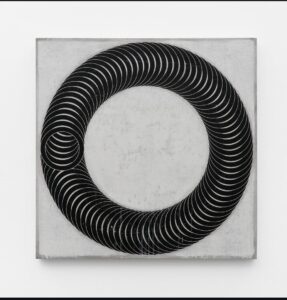
In your work, the repetitive rhythm, even if minimalist, evolves into a progressive articulation that begins with a primary figure, only to eventually return upon itself. This practice serves as a metaphor for that intimate, personal stream of consciousness, through which each individual rediscovers their own spiritual essence. Much like the concept of entropy, it involves moving from chaos, from the irrational, towards an understanding and knowledge of one’s own identity. Could you explain this connection between creative intention and the search for the self?
I believe that human beings exist essentially to understand themselves, and that this progressive emancipation from ignorance coincides with the universe becoming conscious of itself: through us, the cosmos learns to know itself. My own naive approach to this immense concept finds expression in the observation of geometric systems, in their crises and their harmonies.
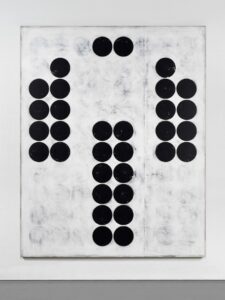
Contrary to what it might seem, I do not begin with chaos or the irrational, rather, I start with a set of simple and linear elements that I can control and comprehend. By combining these essential geometries, I seek to establish a dialogue with the surrounding environment which contains us. The chaos we sometimes perceive is perhaps merely an impression dictated by our human scale. I am convinced that a profound order exists, one that, while not yet self-aware, operates in a way that is both rational and instinctive. It is an order that manifests in the regular rhythms of nature: in waves, breathing, in the heartbeat, and in the propagation of sound and light. I simply observe with admiration, reflect and strive to understand. As the ancients said: As above, so below.
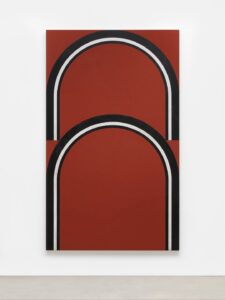
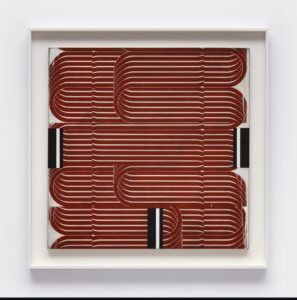
In the works presented in the exhibition Abacus (2026) at the Tina Kim Gallery in New York, by contrast, a different spatial logic is introduced, within more static structures, the color white assumes a more absolute, dynamic role. Furthermore, deeper hues, ranging from vivid red to intense orange are incorporated. What is the reason for this shift?
My connection to white remains the same: it is light and the sum of the entire color spectrum. Red, in its earthier, burnt variations, arises from the need to introduce an element of warmth into the equation of my work, as long as the pieces remained strictly black and white, they lacked the necessary temperature. As I mentioned earlier, my exploration evolves through repetition, much like a probe searching for a passage, mapping out what appears to be a solid space. This repetition brings systemic dissonances to the surface which, over time, lead to a transformation of the system itself. This friction, this internal contrast within the order of the composition, has begun to cause a rise in temperature, a heat that now stands in conflict with the black and white. These thoughts find a fascinating parallel in modern physics. In thermodynamics, the only true molecular distinction between the past and the future lies precisely in an increase in temperature and entropy: time flows only where heat dissipates, transforming order into disorder. Introducing heat through color, therefore, might signify an acceptance of becoming, of the famous arrow of time and the inevitable change of all things. And then there is rust, we can’t forget the rust.
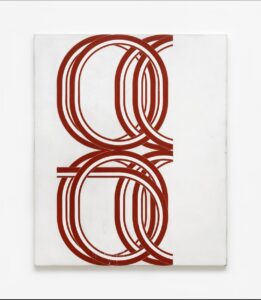
Another disruptive element is the introduction of words which, by becoming a structural factor, compel the viewer to focus more intently on interpreting the work. What led you to incorporate language into your compositions?
I have always had a great love for the written word in painting, yet I have never managed to incorporate letters or digits onto the front surface of my works. The presence of text tends to monopolize the viewer’s gaze, reducing every other formal element to a mere satellite. The numbers that do appear in my work remain confined to the edges of the canvas: small, printed digits corresponding to the lines of the underlying grid. Years ago, I began imprinting these numbers onto the linen rather than erasing them upon completion, this preserves a permanent trace of the initial graphite drawing, the essential framework upon which everything else rests. Words, by contrast, flourish in my works on paper, where they serve as the sole figurative element. They are never titles (my drawings are always untitled, identified only by their date, unlike my paintings, which are numbered chronologically), but are instead added at the very end, as a subsequent decision made once the composition is complete. My drawings represent a distillation of my process, reduced to its most fundamental terms: form, color and thought. The word never describes the drawing. Rather, it acts as a third element, an independent mental image which joins the other ingredients as one engages with and absorbs the work. In general, however, I would always prefer for my works to be felt, recognized and absorbed, rather than interpreted.
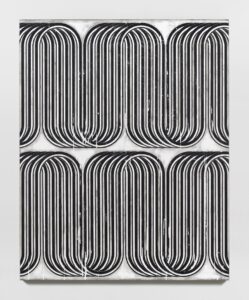
In 2022, you presented the Untitled series at the Cardi Gallery in Milan. These are black and white works created on linen canvases, in which a dialectical clash between contrasting elements – order/disorder, perfection/imperfection, stillness/chaos – lends the paintings a sculptural quality. Could you tell us about this project? And why did you choose linen as your painting surface?
I do not work in cycles or series. My entire body of work stems from a single line of thought, a continuous, albeit slow, evolution of the same underlying reasoning. Like any exhibition, that project served as a survey, a precise snapshot of where my research stood at that specific moment in time. Each exhibition carries the memory of those that came before it, featuring a core body of work representing roughly two years of labor and, occasionally, punctuated by a bold leap toward the future. My transition to using linen occurred between 2019 and 2020, driven by the requirements that arose from incorporating white into my compositional space. Until then, I had primarily painted on wood, an ideal substrate for accentuating the definition of scratches and abrasions against a black background, within two-dimensional compositions, built through layering, yet devoid of any perspectival illusion. However, as white began to take precedence, I felt the need for a surface to which the stucco could adhere more firmly, allowing for the creation of weight, thickness and material complexity. I required a substrate that would highlight the details carved into the surface, revealing the scratches in the black gesso beneath the white top layer.
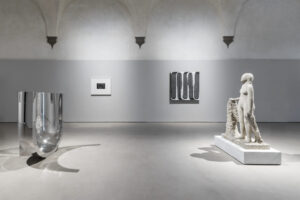
In 2019, you took part in the exhibition L’attesa, part of a series of artistic dialogues titled Duel, held at the Museo del Novecento in Florence. For this project, you engaged with Arturo Martini’s sculpture Susanna (1935) through a series of paintings, photographs, and, most notably, a reflective steel sculpture that mirrors not only the surrounding space, but also the very gaze of Martini’s work. Could you tell us how you conceived this project?
The starting point was the very format of the exhibition: selecting a work from the museum’s permanent collection to establish a dialogue with my own work. Despite the Museo Novecento’s extraordinary collection of paintings, my attention was immediately drawn to a sculpture by Arturo Martini. I was looking for a piece capable of asserting its own physical presence at the center of the room. Furthermore, considering the history of the space, which, until 1976, housed an old school for girls, I was compelled by the idea of including an element that symbolizes the Sacred Feminine. The full title of Martini’s sculpture is L’attesa or Susanna. I was also drawn to the ambivalence of this phrasing, it is as if Susanna herself could be a monument, a symbol of waiting, of the act of waiting. Like a pregnancy, like hope, preparation, growth and life. Or, alternatively, l’Attesa
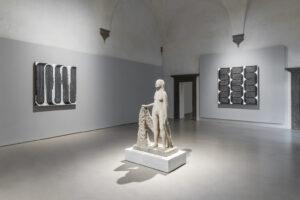
as a divine, almost messianic figure, yet feminine, as I have always believed the divine must be. If one insists on anthropomorphizing the sacred, the mystery, which I find absurd, then it can only be feminine. My work is deeply connected to the dynamics of the unstoppable flows which govern time, space, life and the human condition. Yet, while in my paintings these forms serve as an image of such concepts, in my sculpture there is always an element of containment, a form capable of protecting, cradling, and nurturing. I liked the idea of having a sculpture that mirrored Susanna, both conceptually and physically, and was designed based on her proportions. I wanted there to be a dialogue of gazes: as if Susanna had arrived from a most remote, prehistoric past. And that my work should represent the other point of the unknown, the future which, by definition, remains invisible and, if forced into the immediate present, can only be a projection of our own expectations, a reflection. I wanted the feminine and a sense of reflection to be at the heart of the exhibition, and the central tension to reside in their gaze.
Are there any artists who have influenced your work or who continue to inspire it?
So many. Ellsworth Kelly, Cy Twombly, Anne Truitt, Robert Ryman, Hans Josephsohn… And many contemporaries including Suzan Frecon, Nathlie Provosty, Erik Lindman, Anne Neukamp, David Ostrowski…
Can you tell us about your future projects?
I am currently working on a book reflecting on the last ten years of collaboration with Tina Kim, my gallerist in New York, as well as an exhibition focused on small-scale paintings on ivory.