by Romina Ciulli and Carole Dazzi
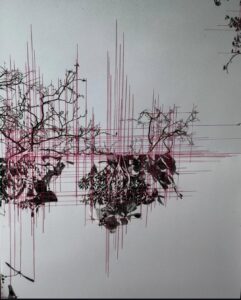
In her works Gisoo Kim uses a unique photographic collage technique, assembling photographs through embroidery. The works of this Korean artist, now based in Germany, are in fact created by stitching together individual image segments, aiming to stimulate not only different perspective combinations, but above all different emotional reactions. Thus, a new reality unfolds before our eyes, composed of visual elements which harmonize and complement each other thanks to the embroidery woven with needle and thread. Let’s talk to the artist.
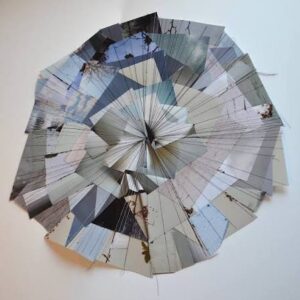
Your photographic collages are characterized by the use of embroidery. Through this technique the images, connected by thread, generate unexpected perspectives, and open up new realities and new interpretative approaches. Can you tell us why you chose this particular artistic practice?
During my sculpture studies in Korea, we had to work with materials such as wood, stone, clay, or metal as part of our coursework. Later, I worked with fabric. Even while I was studying art, I focused primarily on sculptural objects and installations. I began looking for new materials. They needed to be lightweight, since I’m not particularly strong. The material also needed to be lightweight so that it could be easily transported. Furthermore, I wanted to be able to work with the material without needing many tools.
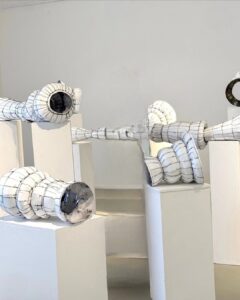
I also looked for everyday materials that are readily available. As I mentioned, I started with fabric. However, this material seemed too tame and conventional to me. So I began working with photographs and yarn. I believe the role of materiality is limitless and full of possibilities. My tools are a needle, a thimble, and scissors; my materials are photo prints and thread. These are all everyday items that are easily available. Photos are readily available, and the subjects in the photos allow me to incorporate different colors, textures, or even motifs and themes. The embroidery creates a relief-like texture on the otherwise smooth surface of the photo, resulting from the small needle holes and the applied thread. This lends the image a new dimension.
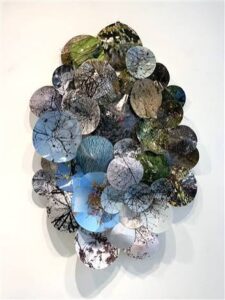
Stitching plays an important role in your collages. It connects, in fact, the various visual elements, sometimes more obvious, sometimes more hidden. This process, in addition to exploring the possible compositional layers of the image, seems to trigger a constant reference to both the real and the imaginary, connecting subjective, collective, and emotional aspects of our experience. So, how much does the personal component influence your creative process?
I find myself caught between German and Korean cultures. My memories, thoughts and actions have both distinctly Korean and German roots. And an important aspect of my work involves combining and blending very different viewpoints and perspectives. In my work, I have developed a new technique in which I create a collage of photos, but instead of using glue or cutting out the photos on a computer, I sew the photos together with thread. In this way, I bring together different places and situations that may be connected in real or surreal ways. The stitches with thread not only serve to connect the various photos, but are also works of embroidery in their own right. By incorporating embroidery into the photographs, the works gain depth, as well as various layers and textures.
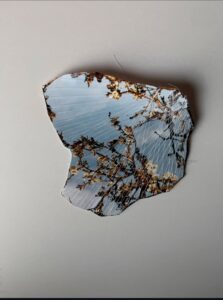
Your works often recall pictorial elements typical of landscape depictions. However, as the gaze moves closer, something more complex, deeper, emerges from the classic image, deconstructing it both stylistically and perceptually. What kind of narrative are you trying to convey to the viewers? And what message would you like them to receive?
That’s precisely what I want to emphasize: that nature is an integral part of humanity and that we cannot live without it, just like things we take for granted. I want to show that we cannot live without nature. The installation, consisting of vessels made of photographic paper, is intended to illustrate the strong connection between humans and nature in the context of our coexistence. Individual landscapes are connected to one another through threads spanning various landscapes. The vessels, sewn from photographs, are also interwoven with one another, forming abstract shapes that we sometimes fail to understand from a distance, but must perceive.
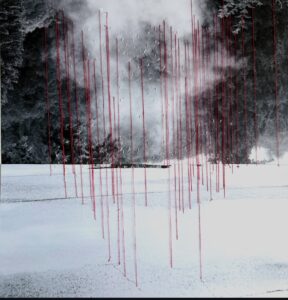
Let’s talk specifically about the series On the way, or the project entitled Diary. In the first, the use of theatrical framing makes the compositions captivating and extremely surreal. In the second series, instead, yarns are used as functional graphic elements, transforming these works into something even more experimental. Can you tell us about these two projects?
Diary (on the way). I started the “diary” project, when I received my two-month fellowship at Seoul Art Space in 2010. I was to work there for two months on the outskirts of Seoul, where the industrial area is undergoing a transformation into a cultural landscape. I wanted to document a landscape – in my own way and as a diary – amidst various situations. I wanted to precisely capture and highlight what had changed and what I now see differently in my old hometown after having left.
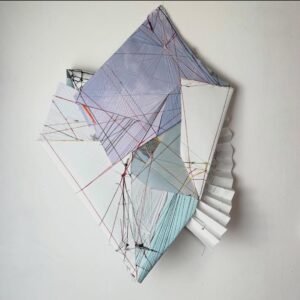
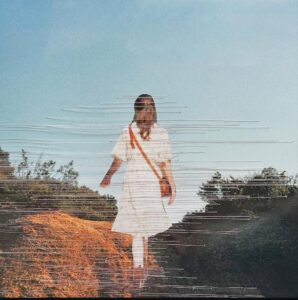
This project reflects the theme of “Two Places,” which complement and positively influence one another. It connects two places that do not belong together, one familiar and one foreign. I combine my own analogue photos with different motifs to create a new work. This is done by stitching the photographs together. The fine embroidery with colorful threads on the photographic surface is like a drawing with needle and thread, as new surreal visual worlds emerge. The visible reality of photography creates new spaces and creates a fictional world of images, both abstract and narrative. The embroidered and sewn elements enter into a surreal dialogue with the photographs and create a second reality, complex and full of poetry.
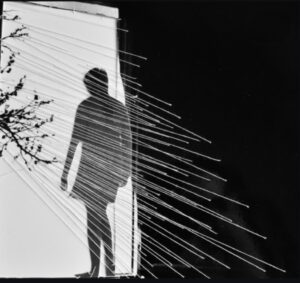
Your collages feature a unique use of light and shadow. The contrast, generated by the images combined with the yarns, both gives the compositions real, almost sculptural forms, and stimulates imaginative, unreal associations. To what extent, then, can interdisciplinary experimentation stimulate the creative dimension?
In a figurative sense, this vessel serves to contain and absorb. Literally, however, it consists of individual photographic images that show not only the front sides, but also the backs of the photos. From a distance, it gives the impression of a confined container, but as one draws closer, one beholds lush, green landscapes within it. Various places and situations are interconnected, offering a glimpse into a new, unique world.
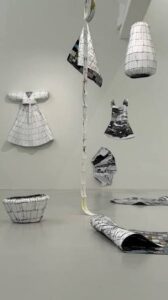
Your artistic journey also includes the creation of clothing and accessories featuring photographic elements. In this case, the visual, seemingly darker elements and the embroidered, lighter elements, transform the object/garment into a medium for exploring various perceptual processes. Why did you choose a medium like fashion to express your research?
I always found photography totally boring because the surfaces are so flat. I wanted to add more layers. So I experimented with different shapes, such as bags and clothing. Everyday shapes as photographic subjects. It is just as essential to us as our work, our family, or our society, if not more so. I create my photo dresses from 10×15 landscape photographs. These are carefully assembled by hand, resulting in a new image. I sew them together with needle and thread, creating hats, dresses, or even bags with a new identity.
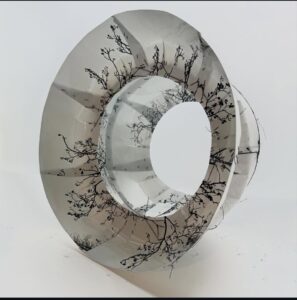
Call and Response is an installation of 15 vases, composed of photographs sewn together with thin threads. On each vase, the human figures occupy a fragmented yet interconnected space, representing the fragility of our social relationships, and the strength of our need for interdependence. Can you tell us how this project was born?
That was the theme of the “House of Paper” photo festival in Berlin in 2025. I was asked if I had an idea for an installation on the theme of communication and attitude. I thought about the connection between people for my installation. The installation, which features vessels created from photographs, aims to illustrate the strong connection between people and society in the context of our shared lives. Individuals are bound together by thread within a close-knit social landscape. The vessels, sewn from photographs, are further intertwined, creating abstract forms that we sometimes cannot fully grasp from a distance. Yet we must look at them more closely and pay attention to one another. The vessels are suspended in the air, forming a single shape.
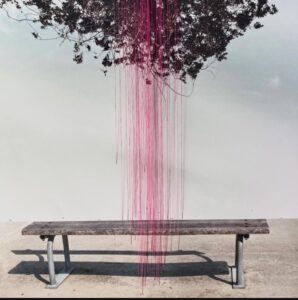
The theme of memory is the basis of the exhibition titled Fäden des Raums. Here, images of the real world always seem, in some way, to allude to aspects of one’s own personal experience. Can you tell us about this project? And what role does memory play in your artistic research?
In my photographs, I capture what I find essential during my travels around the world. I have developed my own method for establishing connections to other places, landscapes, and moments and linking them permanently. I cut up the photographs and sew the individual pieces together to create a new context. Additional embroidery creates connecting lines, conjures up reflections of light in the images, or covers up or conceals certain details. In this way, I create a “second” reality, as collages and as objects in which the new visual worlds either reveal themselves openly. In the tension between reality and fantasy, in the connection of places and moments that do not necessarily belong together, new, poetic images emerge, interwoven with the threads of space.
Are there any artists who have influenced your work or continue to inspire it?
I like Louise Bourgois, Christo and old masters.
What are your future plans?
I’d like to try my hand at large-scale installations featuring landscape motifs.